
Code like a millionaire: what Anthropic's early hires built before they joined
Anthropic's IPO could make about 4,250 employees millionaires, by one estimate. Here are the problems its early hires were solving in public before they joined, and what they built.
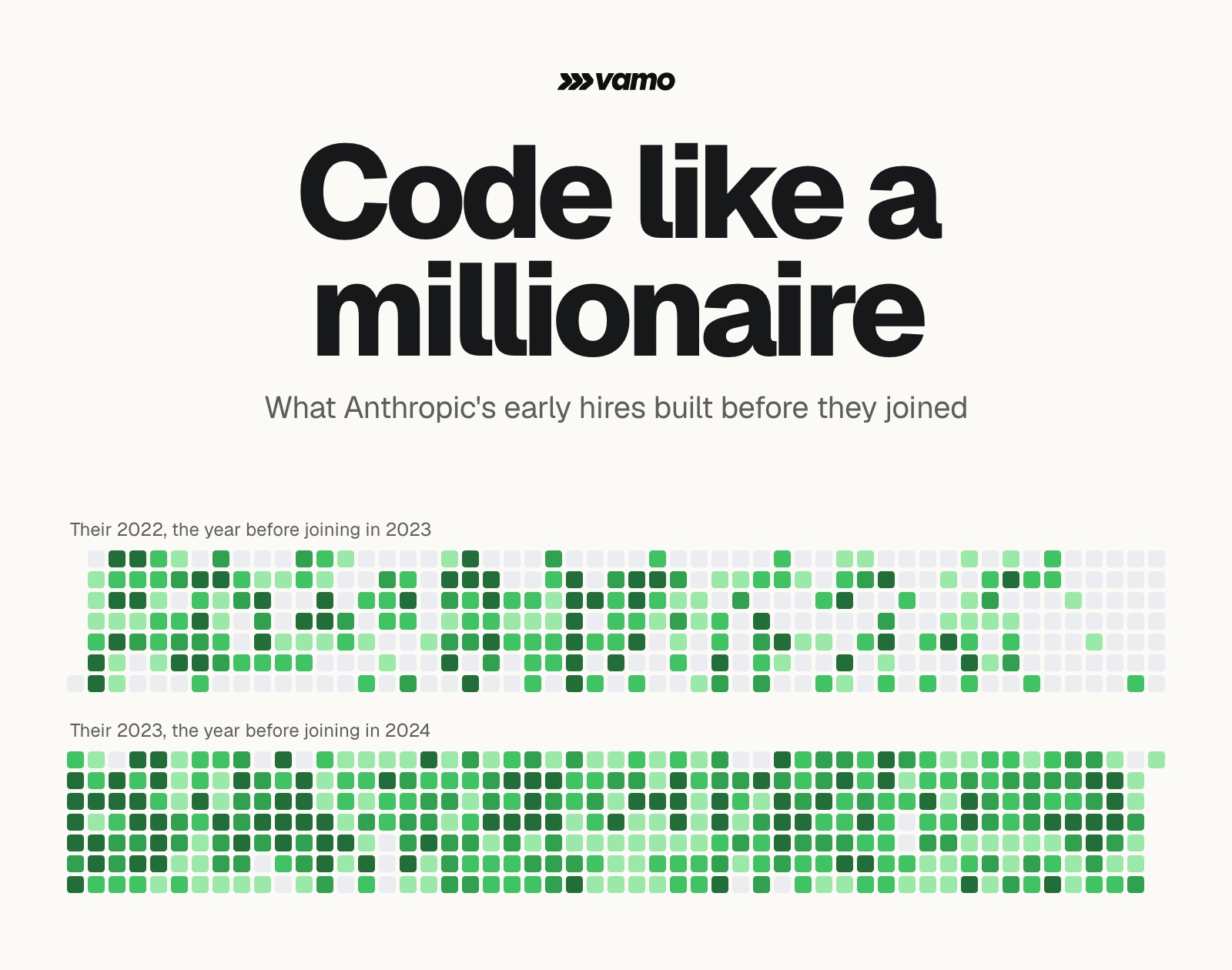
Anthropic priced its IPO at $83 a share on November 18, and the shares start trading on Nasdaq today (Anthropic, CNBC). Hill, a platform that tracks private-market trades, estimates the listing could make about 4,250 of Anthropic's roughly 5,300 employees millionaires (Money.it). That is an estimate about the company as a whole, not about any one person.
So we asked a different question about the people who got there early, in 2022, 2023 and 2024: what problems were they trying to solve before they joined? Their public GitHub work answers it pretty well. Some of them were mapping the wiring of brains or simulating stars. Some kept a tool alive that millions of programs run every week. A lot of them built games, gadgets and things nobody asked for.
Vamo is built on the idea that what someone builds in public is the best evidence of what they will build next, so this was a fair test. Here is the short version.
Six things worth building, if you want to try this
If you're wondering what to build, here are six patterns from the data, each with the number behind it and one real project. They describe one group's public record, not a recipe for getting hired: a third of the group had no public activity at all in the year before they joined, and nobody in it has said a repository got them the offer. The stories behind each one follow.
-
Build a tool other builders use
Tools for programmers were the most common side project, at 16% of the active.
A converter for API descriptions, now 6.5 million downloads a week: bcherny/json-schema-to-typescript by Boris Cherny
-
Fix something in someone else's project, then come back
3 in 4 worked on projects they didn't own, and returners outnumbered drive-bys three to one.
Some of the first changes to the main library for looking inside language models: TransformerLensOrg/TransformerLens by Ansh Radhakrishnan
-
Explain a hard idea with a visual
11% worked on teaching, docs or visual explainers.
Interactive essays about how models behave, then Anthropic's feature browser: PAIR-code/ai-explorables by Adam Pearce
-
Bring the science you already know
22% had science code, and 63% of the interpretability paper authors in the group did.
Brain-mapping methods, pointed at a language model: nicholasturner1/gpt-omics by Nicholas Turner
-
Scratch your own itch
10% built tools for their own day: reading, recipes, workouts, notes.
Typing shortcuts mined from your own emails and Slack messages: eschluntz/compress by Erik Schluntz
-
Finish the weird side quest
55% had a personal project, and games and puzzles came second only to tools.
A 1970s game emulator, finished five years after it was started: kevinji/chip-8-emulator by Kevin Ji
Shares are of people active on GitHub in the year before joining, over the two years before their start year.
Three in four worked on other people's projects
Start with the basics. Two in three of the people we could match were building in public in the year before they joined. Everything below is about them.
67%:made public contributions on GitHub in the year before they joined
The rest of the numbers here are about those people.
Most of that work happened in projects they didn't own. Three in four committed code or proposed a change to someone else's project in the two years before they joined, and most got a change accepted. Nearly half worked on a project popular enough to have 1,000 or more stars on GitHub.
3 in 4:worked on a project they didn't own in the two years before joining
Two stories show the range. In 2022 a small library called TransformerLens appeared that let researchers open up a language model and read what was going on inside. Ansh Radhakrishnan sent some of its very first changes, the ones that load a trained model and record what it does, and two other future Anthropic hires followed within a year.1 At the other end of the range, Justin Spahr-Summers and, years later, another future hire helped keep Tigerbrew, a version of Homebrew, running on Macs from 2005.2
They stuck around: returners outnumbered drive-bys three to one
A one-line typo fix counts as a contribution. That isn't what most of this group did. 29% were maintainers or core contributors on a project with real users, and another 28% kept coming back to the same outside project. Only 19% passed through once and never returned.
57%:kept coming back to the projects they worked on
Maintainers and repeat contributors outnumbered drive-by contributors three to one.
Maintaining is the unglamorous part of open source: answering issues, reviewing other people's changes, shipping releases for years. Two of the longest-running examples in the group show what it looks like at scale. Ned Batchelder has maintained coverage.py, the tool most Python projects use to see which lines their tests miss, since 2004. It now gets about 82 million downloads a week, and he kept shipping it right up to his move to Anthropic in 2024; he worked there until 2025.3 Justin Spahr-Summers was the top committer to ReactiveCocoa and Mantle, two of the most popular libraries for Apple developers in the 2010s, then made the very first commit to Anthropic's TypeScript SDK in early 2023. He worked at Anthropic and has since left to make games.4
Most built small, useful tools, and a few got huge
Most of what these people built on their own was small. Three in four of their side projects have fewer than 10 stars, and only one in ten reached 100. The big, famous projects they touched usually belonged to someone else.
76%:of their own side projects have fewer than 10 stars
Most of what they built was small. The big projects they touched usually belonged to someone else.
A few of their own did get huge, and each one started with a specific annoyance.
The biggest is a converter. Web services describe the shape of their data in a format called JSON Schema, and programmers using TypeScript had to retype every one of those descriptions by hand. In 2016 Boris Cherny wrote json-schema-to-typescript to do it for them, and he kept maintaining it for eight years. It now gets about 6.5 million downloads a week, and more than 32,000 projects on GitHub use it. In September 2024 he joined Anthropic and went on to build Claude Code, which is also written in TypeScript.5
Another is the math under modern AI. Training a model means nudging millions of numbers in whatever direction makes it a little less wrong, and finding that direction is calculus nobody wants to do by hand. Autograd, from a Harvard lab, does it automatically for ordinary Python code, and Google's JAX, now one of the main tools for training large models, grew out of it. Its co-author David Duvenaud worked at Anthropic from 2023 to 2024, leading a team that tested models for safety.6
And some stayed small and charming. Erik Schluntz, a robotics startup co-founder, fed a pile of his own emails and Slack messages into compress, which finds the phrases you type most and suggests shortcuts for them. "Just reading through the results was amusing to see how repetitive some of my writing is," he wrote in the README. He joined Anthropic by 2024.7
More than half wrote no machine learning code
You might expect the people building Claude to have spent the years before writing AI code. Most didn't. 55% touched no machine learning code at all in the two years before they joined, and three in four of the repositories they owned had nothing to do with it. Anthropic says something similar on its careers page: "About half our technical staff had no prior ML experience" (anthropic.com/careers).
55%:wrote no machine learning code in the two years before joining
Anthropic's careers page says about half its technical staff had no prior ML experience.
So what were they working on? Mostly the problems every software team has: websites and apps, servers and data pipelines, tools for other programmers, science. Machine learning libraries were as common as web frameworks, and the research Anthropic is best known for, looking inside models, was among the rarest.
One path in started with charts. Adam Pearce made graphics at Bloomberg and dozens of interactives at The New York Times, from a tax calculator to a map of where refugees come from. Then at Google he made AI Explorables, interactive essays that let anyone poke at a model and watch what it does. His reason, from his own talk notes: "Well-crafted visualizations are the highest bandwidth way of downloading information into our brains." By May 2024 he was at Anthropic, building the interactive feature browser for one of its best-known research papers. hot-server, a tiny live-reload server he wrote for himself in 2016, is still how Anthropic's circuit-tracing website starts up.8
Most came from product companies, not AI labs
Only 9% came straight from another AI lab. Half came from late-stage tech companies like Stripe and Asana, or from startups. Stripe sent more people straight to Anthropic than any other single company, with Google close behind.9
The mix shifted by year. The 2022 hires came most often from late-stage tech companies and universities. By 2023 and 2024, startups and big tech had caught up.
2023 brought the scientists, 2024 the product builders
Split by start year, the group looks like two different hiring waves. The 2023 hires were the busiest in public and the most scientific: 37% had science code, twice the 2024 share. The 2024 hires look more like product engineers, and 57% of them touched no machine learning code before joining. Working on other people's projects held steady across all three years.
The scientists brought stars, brains and viruses
One in five had science code before joining, and the fields were far from AI: stars, brain tissue, the spread of viruses, medical physics. For the people who later wrote Anthropic's papers on reading a model's mind, science was the most common thread of all.
22%:had science code: stars, brains, viruses and the like
Among the authors of Anthropic's two Monosemanticity papers in our group, it was 63%.
Those papers need a little setup. A language model's neurons don't line up neatly with ideas: in one small model Anthropic studied, "a single neuron responds to a mixture of academic citations, English dialogue, HTTP requests, and Korean text." In 2023 and 2024 Anthropic published two papers, Towards Monosemanticity and Scaling Monosemanticity, that pulled those mixtures apart into features a person can name, like DNA, Arabic script or the Golden Gate Bridge. Here is what some of their authors were doing first.
A physicist who studied stars. Stars live for billions of years, so astronomers simulate them instead of watching. Adam Jermyn worked on MESA, the open-source code astronomers around the world use to do that, on the part that models how heat churns inside a star. In October 2022 he built the smallest model he could that still showed the effect he was after: a two-layer toy network "primarily meant for interpretability experiments." A year later he was a core contributor on the first paper.10
A neuroscientist who mapped brain wiring. To understand a brain, scientists slice tissue thinner than a hair, image it and trace every connection between neurons, far too many to do by hand. Nicholas Turner built Synaptor at Princeton to find those connections automatically. In April 2022 he pointed the same idea at a language model, in gpt-omics: "Analyzing the virtual weight connectomes in GPT-like transformers." He was an author on both papers.11
A brain-mapping researcher's year before joining Anthropic
Nicholas Turner's public GitHub contributions in 2022, day by day. Most went into the project that treats a language model like brain tissue.
311 public contributions in 2022
A mathematician who chased viruses. Joshua Batson describes himself as a "Mathematician working on machine learning, computational biology, and infectious disease," and in 2022 kept a small home project in genomic epidemiology, which tracks how a disease spreads by reading its genomes.12
And Wes Gurnee, still in a PhD at MIT, asked whether a language model just memorizes word patterns or builds something like a map. His world-models code found that open models keep track of where places are and when events happened, down to individual "space neurons" and "time neurons." He now works on Anthropic's interpretability team: "I study how Claude's thoughts are organized so that we can read and steer them."13
Our reading: the interpretability team hired scientists who had already built small models to see inside something, and people who could make the result visible. That is our inference, not something Anthropic has said.14
Nobody assigned the best part: games, gadgets and Advent of Code
Boris Cherny has said he looks for "side quests" when he hires: "cool weekend projects," like someone "really into making kombucha" (Business Insider via AOL). That is how he hires now, not how this group was hired. But the group had plenty of side quests.
55%:had a side project nobody assigned them
49% had one with nothing to do with machine learning or science.
We didn't find any kombucha on GitHub. We did find a bike that plays Mario Kart, an ad blocker for anything with an HDMI plug, Ziyad Edher's homemade LED wall, a tool that dates an audio recording from the hum of the power grid behind it, and a lot of Advent of Code.
Games and puzzles were the second most common kind of side project, right behind tools for other programmers, and about a third of the game repos are answers to Advent of Code, the puzzle calendar programmers race through every December. Kevin Ji started a 1970s game emulator in 2018 because he wanted to learn Rust and was "specifically excited about the ability to compile to WebAssembly," which lets it run in a browser. He came back and finished it in July 2023. A year later he was at Anthropic.15
An emulator builder's year before joining Anthropic
Kevin Ji's public GitHub contributions in 2023, day by day: the emulator, a compression library written from scratch, and fixes to a large open-source blockchain.
312 public contributions in 2023
The life tools are the most personal: Adam Pearce's Kindle reading tracker, Ziyad Edher's to-do app for the terminal, Alex Albert's Chrome extension that hides retweets, plus recipe managers, a random workout generator and a tide tracker for one stretch of coast. Hobby code was also where people tried new languages. Rust showed up in their side projects five times as often as in their work.16
Some side quests turned into the job
The most interesting thread in the data runs from the side project to the job. For a handful of people, the thing they built for fun in 2023 was close to what they did at Anthropic a year later. People who had built apps on language models in their spare time went on to write Anthropic's public code at about four times the rate of everyone else.
4x:People who built LLM apps on the side were about four times as likely to write Anthropic's public code
Zack Lee spent early 2023 publishing starter kits for apps built on language models, like create-t3-turbo-ai. Two years earlier he had written about how he landed a job: "If you really want to work for someone, don't ask for permission or submit a resume first. Send them a demonstration of what you can do for them." At Anthropic, by 2024, he worked on Anthropic's own starter apps.17
Barry Zhang spent 2023 building agent side projects, plus a joke repo about stacking agent frameworks: "For the memes until someone actually creates this." In December 2024 he and Erik Schluntz wrote Anthropic's essay Building effective agents, which argues "the most successful implementations weren't using complex frameworks." David Hershey built ScrapeGPT, a web scraper that "Self-heals to debug itself," in 2023, joined Anthropic, and in 2025 set Claude loose on Pokémon Red, live on Twitch.18
The Model Context Protocol, which many AI apps now use to plug into other tools, has a story like this too. David Soria Parra, one of its creators, says it started with an annoyance: copying text "back and forth" between the Claude desktop app and his code editor. "This is not part of a big strategy," he said; "it was literally just me going to a room with Justin." Its first public code was a pull request on someone else's open-source code editor, Zed, in August 2024.19
Their public record peaked the year before they joined
Public activity rose in the year before people joined, then fell off. The median went from about 16 public contributions two years before, to 28 the year before, to 5 the year after they started. The work most likely moved rather than stopped: once people join, most of their new code lives in private repositories or separate work accounts.
What this means if you hire engineers
Read the work before the titles. In this group, the person who built Claude Code had spent eight years maintaining a TypeScript tool, the interpretability team was full of scientists, and more than half the group wrote no machine learning code before joining.
Read how people work on code they don't own. Most of this group did, and the accepted changes and repeat visits show how someone works with maintainers and reviewers.
Read the year before a move, and read the side projects. Once someone is inside a lab, most of their work leaves the public record, and the side projects show what they build when nobody assigns it. If you want to look for yourself, browse engineers on Vamo's public lists and what each one builds, or see how Vamo ranks people by what they've shipped. For more on reading a person's public work, see how to evaluate an engineer's GitHub work.
How we did this
We took the 225 people on Vamo whose Anthropic role started in 2022, 2023 or 2024, including people who have since left, and left out bots, organization accounts and people whose only Anthropic titles were outside engineering and research. About 21% of the group has since left Anthropic, judging by the current employer on their profiles. We counted their public GitHub contributions for each calendar year around their start year, with private repositories removed: commits, pull requests and whether they were merged, issues and repositories created.
A person is "active" if they made at least one public contribution in the calendar year before their start year; 67% were. Unless we say otherwise, every share in this post is a share of the active people, over the two calendar years before their start year. "Maintainer or core contributor" means 10 or more commits or merged pull requests to a project with 100 or more stars, their own or someone else's. "Repeat contributor" means more than three to at least one outside project, below that bar. "Drive-by" means contributing outside but never more than three times to any one project. "Side project" means a repository they owned that was not their job, their research or their teaching material; personal sites, CVs and scratch repos are left out. Project categories are ours, from an organization and repository map, keywords and languages, with hand labels for the long tail.
The group is the people we could match to a GitHub account and an Anthropic role, not every hire from those years. Work history gives start years only, so every "year before" is a calendar year. Commits from separate work accounts are not counted, and star counts are as of November 19, 2026. Download counts are for the week ending November 18, 2026, from npm and PyPI; dependent counts are GitHub's. People with no public activity are not weaker engineers; most professional code lives in private repositories.
We name a person only when a public source shows when they got to Anthropic: their own site or CV, a paper byline or acknowledgment, an interview, or a first commit to an Anthropic repository from an anthropic.com address. The footnotes give each source. Dates marked "by" come from the earliest public evidence we found, so the real start may be earlier. We checked whether each named person still works there against their GitHub profile, their own site and Vamo's current-employer record: people who have left are described as having worked there, and where the sources disagree we only say when they joined. Everyone else is described without a name.
FAQ
What did Anthropic's early engineers build on GitHub before they joined? Two in three of the 2022 to 2024 hires we could match made public contributions in the year before. Three in four of those worked on someone else's project, 55% wrote no machine learning code, and 55% had a side project. Their work ranged from a TypeScript tool with 6.5 million weekly downloads to star simulations, brain-mapping software, game emulators and LED walls.
Did Anthropic's engineers contribute to open source? Most of the active ones did. 75% committed to or proposed a change on someone else's project in the two years before joining, and 62% had a change accepted. Maintainers and repeat contributors outnumbered drive-by contributors three to one.
Did Anthropic's engineers have side projects? 55% of the active people had a personal project in the two years before they joined, and 49% had one that was not machine learning or science. Tools for programmers, games and puzzles, and shell and editor setups were the most common.
Did Anthropic's early hires have machine learning experience? More than half didn't, in public. 55% of the active people touched no machine learning code in the two years before joining. Anthropic's careers page says about half its technical staff had no prior ML experience.
Where did Anthropic's early hires work before? For the job right before Anthropic, 29% came from late-stage tech companies such as Stripe, Asana, Shopify and Robinhood, 21% from startups and 18% from big tech. 9% came straight from another AI lab. Stripe sent the most people of any single company.
How do you get a job at Anthropic? Anthropic's careers page asks applicants to put open-source work at the top of their resume. In this group, the public work that lined up with later jobs was usually a side project or an outside contribution in the same area. No one in the group has said a repository led to their offer.
Sources and credits
json-schema-to-typescript and Claude Code. Built by Boris Cherny (GitHub). Repository, live demo, npm package, GitHub dependents; Ink and Ink #682; Claude Code. Joined Anthropic in September 2024 (The Pragmatic Engineer, and again); side quests quote from Business Insider via AOL. Status: at Anthropic, per his GitHub profile.
coverage.py. Maintained by Ned Batchelder (GitHub). Docs, repository, history, PyPI downloads, GitHub dependents, watchgha. Joined Anthropic in 2024 (his blog, July 2024). Status: has left; he joined Netflix in April 2025 (his blog).
ReactiveCocoa and Mantle. Top committer Justin Spahr-Summers (GitHub). ReactiveCocoa, Mantle, Tigerbrew. At Anthropic by January 2023 (first commit to the TypeScript SDK); co-creator of MCP and top contributor to its TypeScript SDK. Status: has left to make games (jspahrsummers.com).
Autograd and JAX. Co-author David Duvenaud (GitHub). Autograd, PyPI downloads, JAX. Worked at Anthropic from June 2023 to October 2024 as Alignment Evaluations team lead (his CV). Status: has left; now at the University of Toronto.
compress and SWE-bench. Built by Erik Schluntz (GitHub, site). compress, SWE-bench submission, Raising the bar on SWE-bench Verified, Building effective agents. At Anthropic by October 2024. Status: unclear; his GitHub profile lists Cobalt Robotics and Vamo's record lists Anthropic.
Interactive graphics, AI Explorables and hot-server. Built by Adam Pearce (GitHub, roadtolarissa.com). AI Explorables and source, the grokking explorable, talk notes, hot-server, attribution-graphs-frontend, kindle-tracker. At Anthropic by May 2024, credited in Scaling Monosemanticity. Status: at Anthropic, per his GitHub profile.
TransformerLens. Repository, early pull requests #6, #7, #8 and #13 by Ansh Radhakrishnan (GitHub), at Anthropic by July 2023 (commit from an anthropic.com address). Status: at Anthropic, per his GitHub profile. The other two contributors are not named.
MESA and the toy model. Adam Jermyn (GitHub, site). MESA and source, Skye, toy_model_interpretability, Engineering Monosemanticity in Toy Models. At Anthropic by October 2023, as a core contributor on Towards Monosemanticity. Status: at Anthropic, per Vamo's current-employer record.
Synaptor and gpt-omics. Nicholas Turner (GitHub, site). Synaptor, gpt-omics. An author on both Monosemanticity papers, so at Anthropic by October 2023. Status: at Anthropic, per his site.
Genomic epidemiology at home. Joshua Batson (GitHub). gen-epi-at-home, cox. An author on both Monosemanticity papers. Status: at Anthropic, per Vamo's current-employer record.
world-models. Wes Gurnee (GitHub, wesg.me). world-models, Language Models Represent Space and Time. At Anthropic by October 2024, thanked as a colleague in Sparse Crosscoders. Status: at Anthropic, per his site.
The CHIP-8 emulator. Kevin Ji (GitHub, kevinji.com). chip-8-emulator and his write-up, deflate-rs, Solana. At Anthropic by October 2024 (first commit). Status: at Anthropic, per his GitHub profile and site.
The LED wall and other side quests. Ziyad Edher (GitHub): led, led.ziyadedher.com, todo, evm-bench; at Anthropic by April 2024 (his site, archived); status: at Anthropic, per his GitHub profile. David Soria Parra (GitHub): neweden; joined Anthropic in April 2024 (experimentalworks.net); status: at Anthropic, per his GitHub profile. Alex Albert (GitHub): twitter-hider-extension; at Anthropic by September 2023 (commit); status: at Anthropic, per his GitHub profile. Tim Maxwell (GitHub): HitecDServo, os2cx; an author on Towards Monosemanticity, so at Anthropic by October 2023; status: at Anthropic, per Vamo's current-employer record. The other side quests are described without names.
Starter kits. Zack Lee (GitHub). create-t3-turbo-ai, dynamic-interface-web, wove, his 2021 post, claude-quickstarts. At Anthropic by October 2024 (his site, archived). Status: at Anthropic, per his GitHub profile.
Agent side projects. Barry Zhang (GitHub). agent-sim, langchain-chain-chain, Building effective agents. At Anthropic by November 2024 (first commit). Status: at Anthropic, per his GitHub profile.
ScrapeGPT and Claude Plays Pokémon. David Hershey (GitHub). ScrapeGPT, feudal_networks, ClaudePlaysPokemonStarter, TechCrunch. At Anthropic by March 2024 (first commit). Status: at Anthropic, per his GitHub profile.
The Model Context Protocol. David Soria Parra and Justin Spahr-Summers (above). Zed #16103, specification, Introducing the Model Context Protocol, The Creators of Model Context Protocol, Latent Space.
Papers. Towards Monosemanticity, Scaling Monosemanticity, Sparse Crosscoders, Toy Models of Superposition and Circuit Tracing, on transformer-circuits.pub.
The IPO and the company. Anthropic prices its initial public offering, CNBC, Reuters via Investing.com, Money.it, citing Hill's estimate, anthropic.com/careers, checked November 19, 2026.