
How to build an engineering talent map: the 97 engineers behind Nvidia's AI libraries
In an engineering talent map, you group a company's engineers by the system they build, with their location, tenure and the alumni who left. You build it from their public work, not their titles.
An engineering talent map tells you who builds what at a company. You group the engineers by team or system, and you note each person's seniority, location and tenure. Then you add the alumni who left. We build the map from public work (repositories, languages, collaborators) and work history, because titles alone won't get you there.
One of Nvidia's principal engineers works from New York
Bryce Adelstein Lelbach is a principal engineer at Nvidia, and he commits to NVIDIA/cccl, the C++ core libraries, from New York.

C++ standards voice who leads CUDA compute library teams at NVIDIA
Advances CUDA C++ compute libraries for GPU development, following research engineering at Berkeley Lab. Commits to NVIDIA/cccl, a collection of libraries for CUDA C++ development, and contributes to NVIDIA/accelerated-computing-hub, a collection of educational resources for GPU programming.
Active 7 days ago
Advances CUDA C++ compute libraries for GPU development, following research engineering at Berkeley Lab. Commits to NVIDIA/cccl, a collection of libraries for CUDA C++ development, and contributes to NVIDIA/accelerated-computing-hub, a collection of educational resources for GPU programming.
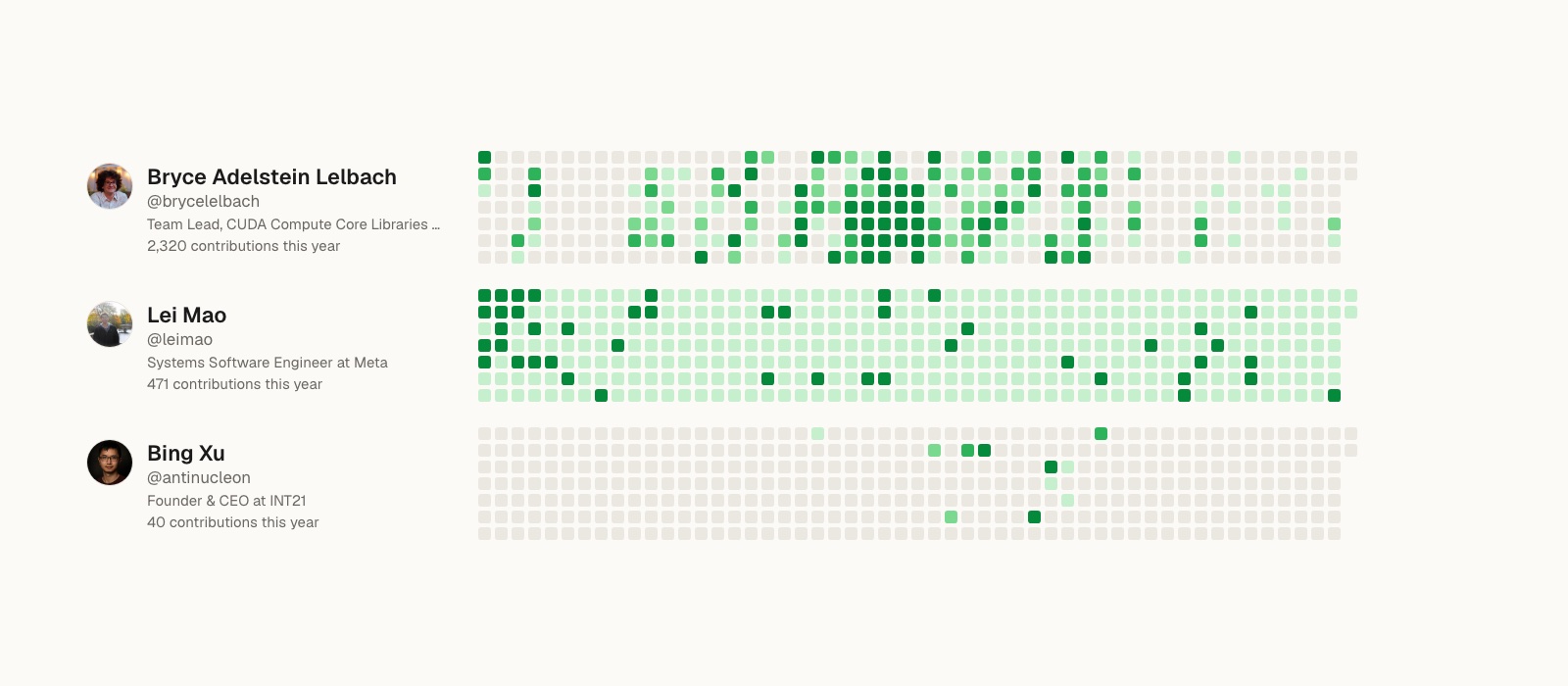
2,320 contributions this year
As of Nov 2026
On Bryce's card, look for NVIDIA/cccl in his repositories, and read his garden to see how much of that work he does in public.
If you mapped Nvidia's C++ library people by searching for the company and assuming Santa Clara, you'd draw the cluster in the wrong place, because one of its senior people works on the other coast.
We only caught that because we started with a narrower question than "who works at Nvidia". We asked who builds Nvidia's open source AI libraries, so we looked at the current and former Nvidia people who contribute to CUTLASS, CCCL, TensorRT-LLM, Megatron-LM, NeMo and GR00T. We keep that group on a public Discover page in Vamo, and when we last pulled it, it had 97 people.
A title search looks complete and answers very little
Most people map a team by searching a professional network for the company name and sorting by title. For an engineering team, you get back something that looks finished, but it doesn't answer much.
Titles are too broad. A company with 300 "Software Engineers" might have 40 people on the inference stack and 60 on the web app, and the rest spread across infrastructure, data and internal tools, and you can't tell from the title which group a person is in. Companies also use seniority labels differently, so a "Senior Engineer" at one company is a "Staff Engineer" at another. And people change teams without updating anything, and some strong engineers barely keep a profile at all.
Lelbach's title says principal engineer, and you only learn that he works on the C++ libraries when you read his commits.
What we learned from the work instead
We fill that gap by reading the work. If an engineer commits to the company's open source inference library, they're on or near the inference team. If two people review each other's pull requests, they work together. If someone who left a year ago is now committing to a brand new repository, you want to know about it.
When we counted across all 97 people, here's what we found.
Location. 64 people list a location in the United States and 14 list one in China. A handful each are in Germany, Canada, Spain, the UK and India. The largest single cities are San Francisco, Santa Clara and Shanghai, followed by Seattle, Beijing and New York.
Language. In each person's top repositories, we saw Python far ahead, then C++ and then CUDA. That's what you'd expect, because people write model and training code in Python and do performance work in C++ and CUDA.
Employer. 82 of the 97 people work at Nvidia today. The other 15 work at Meta, AMD, Apple, Anthropic, DeepSeek, MLCommons, a university and several new companies.
That employer count is the part we use most, because it tells you who left.
Where the 15 alumni went
We usually learn the most from the alumni on a map, because they show where a team's people go next, and some of them start companies. Two of the 15 took the two different paths out.
Lei Mao did deep learning systems engineering at Nvidia, and now he works on deep learning systems and CUDA optimization at Meta. That's the first path, where an Nvidia performance engineer moves to an AI lab's infrastructure team and keeps doing the same kind of work.

Systems engineer at Meta optimizing CUDA for deep learning
Works on deep learning systems and CUDA optimization at Meta, after deep learning systems engineering at NVIDIA. Creator of Voice-Converter-CycleGAN, a voice converter using CycleGAN, and CUDA-GEMM-Optimization, a matrix multiplication optimization for CUDA.
Active 4 days ago
Works on deep learning systems and CUDA optimization at Meta, after deep learning systems engineering at NVIDIA. Creator of Voice-Converter-CycleGAN, a voice converter using CycleGAN, and CUDA-GEMM-Optimization, a matrix multiplication optimization for CUDA.
471 contributions this year
As of Nov 2026
On Lei's card, open his repositories to see that the CUDA and deep learning systems work kept going after he moved to Meta.
Bing Xu was a distinguished engineer at Nvidia. Bing Xu's profile now lists founder and CEO of INT21, and the public work includes contributions to tinyflow and mshadow. That's the second path, where an engineer leaves to start a new company. We wrote up how investors look at that path in how VCs use GitHub to find technical founders.

Founder building deep learning systems tooling at INT21
Builds deep learning systems tooling at INT21, after distinguished engineering at NVIDIA. Contributes to tqchen/tinyflow, a tutorial for building a deep learning system, and dmlc/mshadow, a library for machine learning matrix operations.
Active 3 months ago
Builds deep learning systems tooling at INT21, after distinguished engineering at NVIDIA. Contributes to tqchen/tinyflow, a tutorial for building a deep learning system, and dmlc/mshadow, a library for machine learning matrix operations.
40 contributions this year
As of Nov 2026
On Bing Xu's card, look for tinyflow and mshadow in the repositories, and check the garden for what Bing Xu has shipped since leaving Nvidia.
Each name links to the person's live Vamo profile, so you can see what they build today and not only what they built when we wrote this.
How you can rebuild the map for any company
We built those numbers in five steps.
We picked the systems, not the whole company. "Map Nvidia" is too big a question to be useful, but you can answer "map the engineers who build Nvidia's open source AI libraries". Write down the two or three systems that matter to you. For an AI infrastructure company, that might be the inference runtime, the training framework and the compiler. Then find the public repositories for those systems, because most companies publish some of their core work.
We pulled current and former engineers together. We combine work history with contribution data. If someone contributes to the company's repositories and lists the company as their employer, they're on the team. If someone contributes but works elsewhere, they're usually a partner or a user.
We grouped people by what they work on. We cluster people by repository and language, not by title. On an AI infrastructure team you'll usually see people doing CUDA and C++ library work, people writing Python training and model code, and people on serving and deployment, and each of those clusters is roughly a team.
We judged seniority from the work. Work history gives you tenure, and the work itself gives you seniority. The people who have maintained a core library for years are senior whatever their title says, and so are the people who review most of the merges and the people whose names show up on design discussions.
We looked at who they build with. The repositories people share tell you a lot. If two engineers have contributed to the same three projects over five years, they probably know each other well, and that's often how teams move together.
What this method can't see
When you build a map this way, you only see the work people do in public. Most professional code lives in private repositories, so a quiet profile doesn't mean a weak engineer. The counts show you the shape of a team, but they aren't a census of it.
We also keep the map to public work and public professional history. We don't scrape private data, and we keep personal contact details out of any map we share around.
Show the counts first and the people second
When we share a map, we lead with the counts by team, metro, language and prior employer, because those are what a hiring manager, a partner or an investment committee actually decides on. The individual people go underneath, each with the work that put them on the map.
We use that order because a team is more than its three most visible engineers, so the counts show you the shape and the people are examples of it.
Here's how teams use a finished map:
- Competitive hiring. You find the cluster you need and see who has left recently.
- Acqui-hire and diligence. You see how deep a team really is on the system you care about, and whether its key people are still there.
- VC portfolio support. You help a portfolio company find engineers from teams that have solved the same problem. There's more on how investors use this on the VC page.
- Pitching clients. Agencies build the same map to show a client where the people are, and we cover that on the recruiting agencies page.
We'd start with the alumni at the company you care about. On our Nvidia map, roughly one in six of the people who build Nvidia's systems in public had already moved on, and one of the senior people didn't live where we assumed.
Appendix: run the search yourself
You can ask Vamo in plain language from Claude or another AI tool, or you can call the API. With this request, you find people who used to work at Nvidia, no longer work there, and work in machine learning engineering, AI research or infrastructure, and we rank them with Vamo's benchmarks:
Ask Claude
API request
curl -X POST https://api.vamotalent.ai/v2/developers/search
  -H "Authorization: Bearer vamo_sk_..."
  -H "Content-Type: application/json"
  -d '{
    "filters": ["And", [
      ["past_company_ids", "ContainsAny", { "company": ["NVIDIA"] }],
      ["title_function", "In", ["ml_eng", "ai_research", "infra"]],
      ["is_bot", "Eq", false],
      ["is_org_account", "Eq", false]
    ]],
    "sort": "devrank"
  }'
You'll find every filter, sort and field you can send in the search API reference.
To map the current team, swap past_company_ids for current_company_ids. To find the people who build alongside a team, start from a repository instead: add a repos field that names NVIDIA/cccl and set hops to 2. You can browse repositories and engineers to pick a starting point. If you want the broader picture of what this kind of data can and can't answer, read talent intelligence for engineering teams.
FAQ
What is engineering talent mapping? It means building a structured view of who works on what in a company's engineering team. You group the engineers by system or team, note their location, seniority and tenure, and then add the alumni who have left.
Can I build a talent map from LinkedIn alone? You can get names and titles, but titles don't tell you which system someone works on. When you look at public work like repositories and contributions, you can see the actual teams.
What is the best way to map AI engineering talent at a company? Pick the two or three systems that matter, such as the inference runtime or the training framework, and start from their public repositories. Join contribution data to work history to pull current and former engineers. Then group people by repository and language, judge seniority from the work, and look at who they build with.
How do VCs use talent maps? VCs use them for diligence on how deep a team is and to help portfolio companies hire. They also use them to spot senior engineers who have left a strong team to start something.
How often should a talent map be updated? For active hiring, we update it monthly. People move, and when someone leaves to start new work, you want to know before that news goes stale.
Is talent mapping legal and ethical? Building a map from public work and public professional history is standard practice. We keep contact details out of the maps we share.