
The best Metaview alternatives for sourcing engineers in 2026
The best Metaview alternatives for sourcing engineers are Vamo, SeekOut, Pin, Juicebox, Gem, hireEZ and LinkedIn Recruiter. Metaview pricing, ratings and reviews, and what each alternative costs.
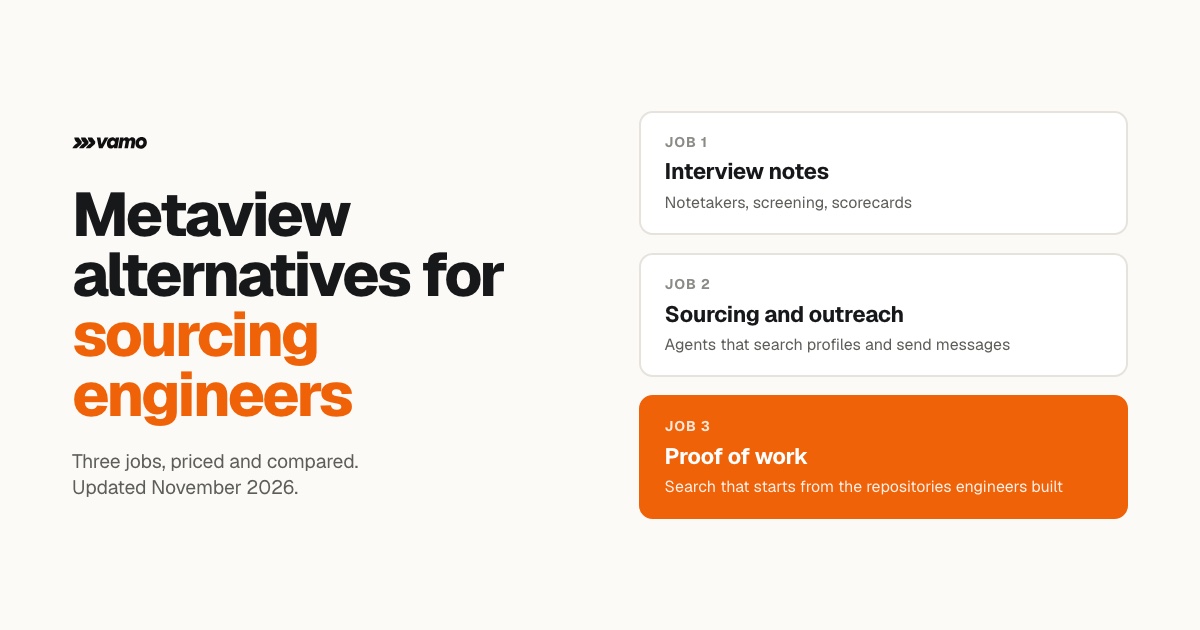
The best Metaview alternatives for sourcing engineers are Vamo for finding engineers by the repositories they built and contributed to, SeekOut for broad search with GitHub among its sources, Pin and Juicebox for AI sourcing and outreach with free plans, and Gem for a recruiting CRM. If you hire at enterprise volume on top of an ATS, hireEZ and LinkedIn Recruiter are the usual picks.
Metaview started as an AI notetaker for interviews and is now an agentic recruiting platform: a Sourcing agent with plans from $0 to $300 per user a month, fillmore, an outbound agent that lives in Slack, plus application review, screening, notes and reports. Its strength is that interviews, sourcing and outreach share one workspace. Engineering teams look at alternatives when they want to start a search from the code itself: who contributed to a repository, where they work now and where they live, in one query.
Updated November 25, 2026. We make Vamo, so weigh what we say about it. Every claim about another tool comes from its own site, read on November 23, 2026, and so are the G2 and Capterra ratings. Prices change, so check them before you buy.
The short version: the best Metaview alternative for each job
- Engineers found by the repositories they built and contributed to: Vamo.
- Broad search with GitHub among its sources: SeekOut.
- AI sourcing and outreach with a free plan: Pin or Juicebox.
- A recruiting CRM with sourcing built in: Gem.
- Enterprise outbound on top of an ATS: hireEZ.
- Reaching people through LinkedIn and InMail: LinkedIn Recruiter.
Metaview alternatives at a glance
| Tool | What it does | How it finds engineers | Use it from | Pricing as published | Best for |
|---|---|---|---|---|---|
| Vamo | Search and analytics over what engineers built on GitHub, joined to career and location | Repositories owned and contributed to, ranked against engineers like them, with the reason each person matched | App, API, MCP in Claude, ChatGPT, Cursor, Codex and Gemini CLI | Usage-based (book a demo) | Engineering sourcing by repository, employer and city |
| Metaview | Sourcing agent, fillmore outbound agent, interview notes, screening and reports | Profiles from third-party providers plus web research, including GitHub, and your ATS | Web app, Slack (fillmore), MCP in Claude and ChatGPT | Sourcing Free $0; Pro $100 per user a month ($60 for the first 12 months for new customers); Max $300; Enterprise custom | Teams that want sourcing, outreach and interview notes in one platform |
| SeekOut | AI recruiting search, sourcing and outreach | Many sources, including "patents, GitHub, publications" | Web app, MCP in every plan | Sourcing Core $149 a month billed annually or $179 monthly, up to 3 seats; 14-day trial | Teams hiring many role types with GitHub as one signal |
| Pin | AI recruiter from job description to booked interview | Its own ranker, tuned per job from your accepts and rejects | Web app, MCP on every paid plan | Free plan; Solo $100 and Professional $135 per user a month billed annually; Enterprise custom | Hands-off sourcing and outreach |
| Juicebox | Natural-language people search, outreach and Juicebox Agents | Relevance over many third-party sources | Web app, MCP on paid plans | Free plan; Starter $99 and Growth $179 per seat a month billed yearly ($119 and $199 monthly); Business custom; Agents $199 per agent a month | Small teams and agencies, any role |
| Gem | Recruiting CRM, AI sourcing, outreach and analytics, with an optional ATS | AI sourcing on AI-Powered seats | Web app, GeMCP | Custom by company size; startup program $130 a month billed yearly for 1 to 10 people; under 30 employees get six months free | Running the whole process in one platform |
| hireEZ | Agents for sourcing and outreach on top of your ATS | "1B+ profiles across 45+ platforms" | Web app, MCP in controlled release | Solo recruiters from $494 a month with a 7-day trial; enterprise custom | Enterprise outbound at volume |
| LinkedIn Recruiter | Search and InMail across LinkedIn, with Hiring Assistant | LinkedIn profiles | Web app | Not published; Recruiter Lite includes 30 InMails a month, Recruiter up to 150 a month per seat | Reaching people through their LinkedIn profile |
Metaview pricing
Metaview Sourcing has a Free plan with 100 filtered and 100 agentic profiles, Pro at $100 per user a month ($60 for the first 12 months for new customers), Max at $300 per user a month, and a custom Enterprise plan. Every Sourcing plan includes unlimited emails and phone numbers for the candidates you find there, subject to fair use. The full Agentic Recruiting Platform, with notes, screening and fillmore, is custom priced. Read on metaview.ai/pricing on November 23, 2026.
Metaview and its alternatives on G2 and Capterra
| Tool | G2 | Capterra |
|---|---|---|
| Metaview | 4.8 (132 reviews) | No listing found |
| SeekOut | 4.5 (799 reviews) | 4.7 (189 reviews) |
| Pin | 4.8 (29 reviews) | 5.0 (2 reviews) |
| Juicebox | 4.8 (105 reviews) | No listing found for the recruiting tool |
| Gem | 4.7 (315 reviews) | 4.7 (126 reviews) |
| hireEZ | 4.6 (264 reviews) | 4.7 (103 reviews) |
| Vamo | Not listed yet | Not listed yet |
Ratings read on G2 and Capterra on November 23, 2026.
Metaview reviews: what users say
Metaview holds 4.8 out of 5 on G2 from 132 reviews (November 23, 2026), and 95% of them are five stars. Reviewers praise how easy it is to use, the AI interview notes that let them stay present in the conversation, and the time saved on debriefs. The complaints G2 tags most are transcription accuracy, especially in other languages and with accents, limited customization of summaries, and ATS integrations that sometimes drop. Nearly all of these reviews are about the notetaker, so they tell you little about the Sourcing agent yet.
Metaview vs Pin
Metaview and Pin both run a sourcing agent with outreach, and both have free plans. Pin is built around sourcing: it takes a job description to a booked interview, ranks people with its own ranker tuned from your accepts and rejects, and costs $100 per user a month on Solo, billed annually. Metaview builds sourcing on top of its interview notes, so it can also search your ATS and past conversations, and its Sourcing Pro plan is $100 per user a month after a $60 first year. Both hold 4.8 on G2, Pin from 29 reviews and Metaview from 132. Pick Pin for sourcing and scheduling run for you, and Metaview if your team already records interviews in it. For engineering roles, add a search that starts from the code.
What Metaview does well
Credit where it is due. Metaview's notetaker is why many recruiting teams know the name, and its Sourcing agent builds on that context: it can search your ATS and past interviews alongside outside profiles, so a candidate you spoke to last year can surface again. The Sourcing plans publish their prices, the Free plan includes 100 filtered and 100 agentic profiles, and every plan includes unlimited emails and phone numbers for candidates you find there, subject to fair use.
fillmore, launched in June 2026 and open to everyone since September, takes a brief in Slack, researches candidates, writes outreach by email, LinkedIn and WhatsApp, and books screening calls. Metaview's November update added a prompt for "candidates without LinkedIn profiles", with evidence linked for each match. If your team already runs interviews through Metaview, keeping sourcing in the same place is a real advantage.
Split the job: notes, sourcing and proof of work
Recruiting software now covers three jobs, and most teams buy for them separately:
- Interview notes and screening. Metaview, along with tools built around the interview itself.
- Sourcing and outreach. Metaview, Pin, Juicebox, SeekOut, hireEZ and Gem all run searches and send messages.
- Proof of work for engineers. Search that starts from code: the repositories someone owns, the projects they contribute to and who they build alongside.
The third job is where Vamo sits. Vamo reads what engineers built and contributed to on GitHub, joins it to their work history and location, and ranks the work against engineers like them. Vamo sells search and analytics to companies. Each result says which repository or role made the person match, so a recruiter can explain the shortlist to a hiring manager in one line per person.
1. Vamo: best for sourcing engineers from the code
Vamo lets you name a repository, an employer, a seniority and a metro in one search, and returns the same people every time you run it. The Vamo MCP server runs that search from inside Claude, ChatGPT, Cursor, Codex or Gemini CLI with four tools: search, similar, enrich and deep_research. You can ask Claude for "staff engineers in the Bay Area who contributed to Kubernetes", get the list with reasons, then ask for more people like the best one, all in one chat. Our guide to GitHub sourcing tools compares the GitHub-first options.
- Pricing: usage-based. Book a demo to see it on your roles.
- Limits: public GitHub work only, and no interview notes or outreach sequences.
- Best for: engineering sourcing by repository, employer and city.
2. SeekOut: best for broad search with GitHub as one signal
SeekOut reads "patents, GitHub, publications" among its sources and includes its MCP in every plan. Our SeekOut review covers its plans in detail.
- Pricing: Sourcing Core $149 a month billed annually ($179 monthly) for up to 3 seats; 14-day trial.
- Limits: search first, without interview notes.
- Best for: teams hiring many role types.
3. Pin: best for hands-off sourcing and outreach
Pin takes a role from job description to booked interview and has a free plan. Our Pin alternatives post compares the agent-style tools.
- Pricing: free plan; Solo $100 and Professional $135 per user a month billed annually.
- Limits: profile-based ranking for engineers.
- Best for: small teams who want the top of the funnel run for them.
4. Juicebox: best for natural-language search
Juicebox searches with plain-English queries and adds Agents at $199 each a month that keep sourcing for a role.
- Pricing: free plan; Starter $99 and Growth $179 per seat a month billed yearly.
- Limits: credits are capped on self-serve plans.
- Best for: small teams and agencies, any role.
5. Gem: best for a CRM with sourcing built in
Gem combines CRM, outreach and analytics, can replace your ATS, and has a startup program.
- Pricing: custom by company size; startup program $130 a month billed yearly for 1 to 10 people.
- Limits: no list price for larger teams.
- Best for: running the whole process in one platform.
6. hireEZ: best for enterprise outbound
hireEZ runs agents for sourcing and outreach on top of your ATS across "1B+ profiles across 45+ platforms".
- Pricing: Solo recruiters from $494 a month with a 7-day trial; enterprise custom.
- Limits: MCP is in controlled release.
- Best for: enterprise outbound at volume.
7. LinkedIn Recruiter: best if you live in LinkedIn today
LinkedIn Recruiter reaches people through their profile and InMail, with Hiring Assistant. Our LinkedIn Recruiter alternatives post covers when to add a GitHub search beside it.
- Pricing: not published; Recruiter Lite includes 30 InMails a month, Recruiter up to 150 a month per seat.
- Limits: it searches LinkedIn profiles only.
- Best for: reaching people through their LinkedIn profile.
An example search: Kubernetes contributors in the Bay Area
To show what starting from the code looks like, we ran one search in Vamo on November 23, 2026: people who contributed to kubernetes/kubernetes and live in the Bay Area, with the strongest first.
The search returned 43 contributors. Nine of them hold staff or principal titles today. Twenty-five work at Google now, which tells a recruiter at another company to add "excluding current Google" before reaching out. The rest work at companies including CoreWeave, NVIDIA, AMD, Microsoft, Cloudflare, Apple, Salesforce and Render.
Then we asked for more people like one of the staff engineers, in the same metro. The first page of 20 came from neighboring projects: contributors to kubernetes/enhancements, GoogleContainerTools/kaniko and kubevela/kubevela. That second step is how a shortlist grows past the people who touched one repository.
Here is the request, which you can send through the API or ask for in plain words over MCP:
{
	"repos": { "names": ["kubernetes/kubernetes"], "role": "contributor" },
	"filters": ["And", [
		["location_ids", "ContainsAny", { "place": ["Bay Area"] }],
		["title_level", "In", ["staff", "principal"]],
		["is_bot", "Eq", false],
		["is_org_account", "Eq", false]
	]]
}
How to source engineers by their GitHub work yourself
You can test the proof-of-work approach for free before you buy anything:
- Pick two or three repositories your team depends on. Open each one, then Insights and Contributors, for its top 100 contributors.
- Use commit search, such as
repo:kubernetes/kubernetes author-date:>2026-06-01, to see who is active now. - Search users with qualifiers such as
type:user location:"San Francisco" language:go followers:>20. The GitHub user search docs list them all. - Read each person's pinned repositories and their strongest pull request, then look up where they work today.
- Keep a sheet of who you found, which repository brought them in, and where they work, so the next search starts from it.
This works well for a dozen people and one city. A tool earns its price when you run it across many repositories, employers and metros every week.
FAQ
What are the best Metaview alternatives for sourcing engineers?
Vamo for finding engineers by the repositories they built and contributed to, SeekOut for broad search with GitHub among its sources, Pin and Juicebox for AI sourcing and outreach with free plans, Gem for a recruiting CRM, and hireEZ or LinkedIn Recruiter for enterprise volume.
How much does Metaview cost?
Metaview Sourcing has a Free plan, Pro at $100 per user a month ($60 for the first 12 months for new customers), Max at $300 per user a month and a custom Enterprise plan. The full Agentic Recruiting Platform is custom priced (read November 23, 2026).
What do Metaview reviews say?
Metaview has 4.8 out of 5 on G2 from 132 reviews (November 23, 2026). Reviewers praise the interview notes and ease of use, and the main complaints are transcription accuracy in other languages and limited summary customization. Nearly all reviews cover the notetaker rather than the Sourcing agent.
Is Metaview or Pin better for sourcing?
Pin is built around sourcing and scheduling, from $100 per user a month billed annually. Metaview builds sourcing on its interview notes and can search your ATS and past conversations, with Sourcing Pro at $100 per user a month after a $60 first year. For engineers, add a search that ranks people by their code.
Does Metaview search GitHub?
Yes. Metaview's sourcing agent builds profiles from third-party providers and researches candidates across the web, and its own pages say that includes GitHub activity and open-source contributions. Vamo starts the other way round, from the repositories people own and contribute to, and joins that to their career and location.
What is Metaview fillmore?
fillmore is Metaview's outbound recruiting agent. You brief it in Slack with a job description or example profiles, and it finds candidates, writes outreach by email, LinkedIn and WhatsApp, and books screening calls. It launched in June 2026 and opened to everyone in September 2026.
Is Metaview or Juicebox better for hiring engineers?
Both search outside profiles and run outreach. Juicebox publishes seat prices from $99 a month billed yearly; Metaview Sourcing starts free and adds interview notes and screening in the same platform. If engineers are most of your hiring, add a search that ranks people by their code, such as Vamo.
Which Metaview alternatives have an MCP server?
Vamo, SeekOut, Pin, Juicebox and Gem all publish one, and Metaview has its own. Vamo's MCP runs the developer search itself, with search, similar, enrich and deep_research, so you can build and grow an engineering shortlist from inside Claude, ChatGPT or Cursor.