
How to find and hire CUDA and GPU kernel engineers (2026)
To find and hire CUDA and GPU kernel engineers, look at who commits kernel code to open-source projects like FlashAttention, Triton, CUTLASS and DeepGEMM, read what they changed and how maintainers reviewed it, and then reach out about that work.
To find and hire CUDA and GPU kernel engineers, look at who commits kernel code to the open-source projects where that work happens: Dao-AILab/flash-attention, triton-lang/triton, NVIDIA/cutlass, deepseek-ai/DeepGEMM and HazyResearch/ThunderKittens. Read what each person changed and how the maintainers reviewed it. Then reach out to them about that specific work.
Why job boards and LinkedIn keyword search miss kernel engineers
Most kernel engineers have a plain title on their profile, such as "Software Engineer" or "Member of Technical Staff". When you search LinkedIn for "CUDA", you get everyone who typed the word into their skills, and that list mixes people who write kernels with people who once installed a GPU driver. You can see the same problem on staffing pages. When we read Toptal's CUDA page in November 2026, the first freelancer listed had a skill list built around Kubernetes, Terraform and AWS, with CUDA as one tag among many.
The engineers you want rarely apply to job posts, because teams that train or serve large models already know who they are. So you find them through the code they wrote, which is public and dated.
Where GPU kernel work lives in public
A small set of repositories holds a large share of public kernel work. We pulled these numbers from the GitHub API on November 23, 2026.
| Repository | What it is | Stars | Created |
|---|---|---|---|
| Dao-AILab/flash-attention | Fast and memory-efficient exact attention | 25,336 | May 2022 |
| triton-lang/triton | The Triton language and compiler | 20,624 | Aug 2014 |
| NVIDIA/cutlass | CUDA templates and Python DSLs for linear algebra | 10,757 | Nov 2017 |
| deepseek-ai/DeepGEMM | Tensor core kernel library for LLM primitives | 9,224 | Feb 2025 |
| HazyResearch/ThunderKittens | Tile primitives for fast kernels | 3,808 | Mar 2024 |
Each repository has a few people who wrote most of it. Tri Dao (tridao) is the top committer to flash-attention, and he is the first author on the FlashAttention papers listed in its README. Philippe Tillet (ptillet) is the top committer to Triton, and the README points to his 2019 MAPL paper with H. T. Kung and David Cox as the foundation of the project. On CUTLASS, hwu36 has the most commits. On DeepGEMM, LyricZhao has the most commits by a wide margin. ThunderKittens has two committers close to even at the top, benjaminfspector and StuartSul.
The people one level down from the founders are often the better hires. Those engineers ship real kernels, but no recruiter has written to them about a famous paper yet. In Triton, Jokeren, ThomasRaoux, peterbell10 and lezcano each have hundreds of commits. In flash-attention, drisspg is second in commits after tridao.
What to read in a pull request to judge kernel skill
You don't need to write CUDA to tell a strong kernel PR from a weak one. Four things show up in good kernel work.
- Benchmarks in the PR itself. A strong kernel author posts throughput numbers before and after the change, on named hardware. DeepGEMM's README links its April 2025 PRs (#74, #78, #81, #86) next to a claim of up to 1550 TFLOPS on H800, so you can open each PR and see who did the work.
- Code paths for a specific GPU generation. Kernel engineers write separate code for each NVIDIA architecture. flash-attention keeps a
hopperdirectory for FlashAttention-3, which its README says targets H100 and H800 GPUs. DeepGEMM added SM90 and SM100 support in July 2025. When a person's commits touch these paths, they are working at the hardware level. - Numerics tests. Low-precision kernels in FP8 or FP4 can drift from the reference result. Good authors add tests that compare their output against a slower reference and set an explicit tolerance.
- The review thread. Read how the maintainers responded to the PR. When a maintainer asks about register pressure or shared memory layout, watch whether the author answers with a measurement. An author who answers with a number has done this before.
How to approach a kernel engineer
Name the kernel or the PR in your first sentence. A kernel engineer gets many messages that say "I saw your impressive GitHub profile", and those messages get ignored. A good first line reads like this: "I read your PR that [describe the change] in [repository], and our team is working on the same problem on [hardware]."
After that, say what the team does on GPUs today. Tell them which hardware you run, which kernels are the bottleneck, and who they would work with. Kernel engineers care about the problem and the hardware access, so put both in the first message. Keep the message short, and send it through a channel the engineer lists publicly. Don't open an issue or comment on their repository to recruit them.
A do-it-yourself method with GitHub
You can build a first list in an afternoon with free tools.
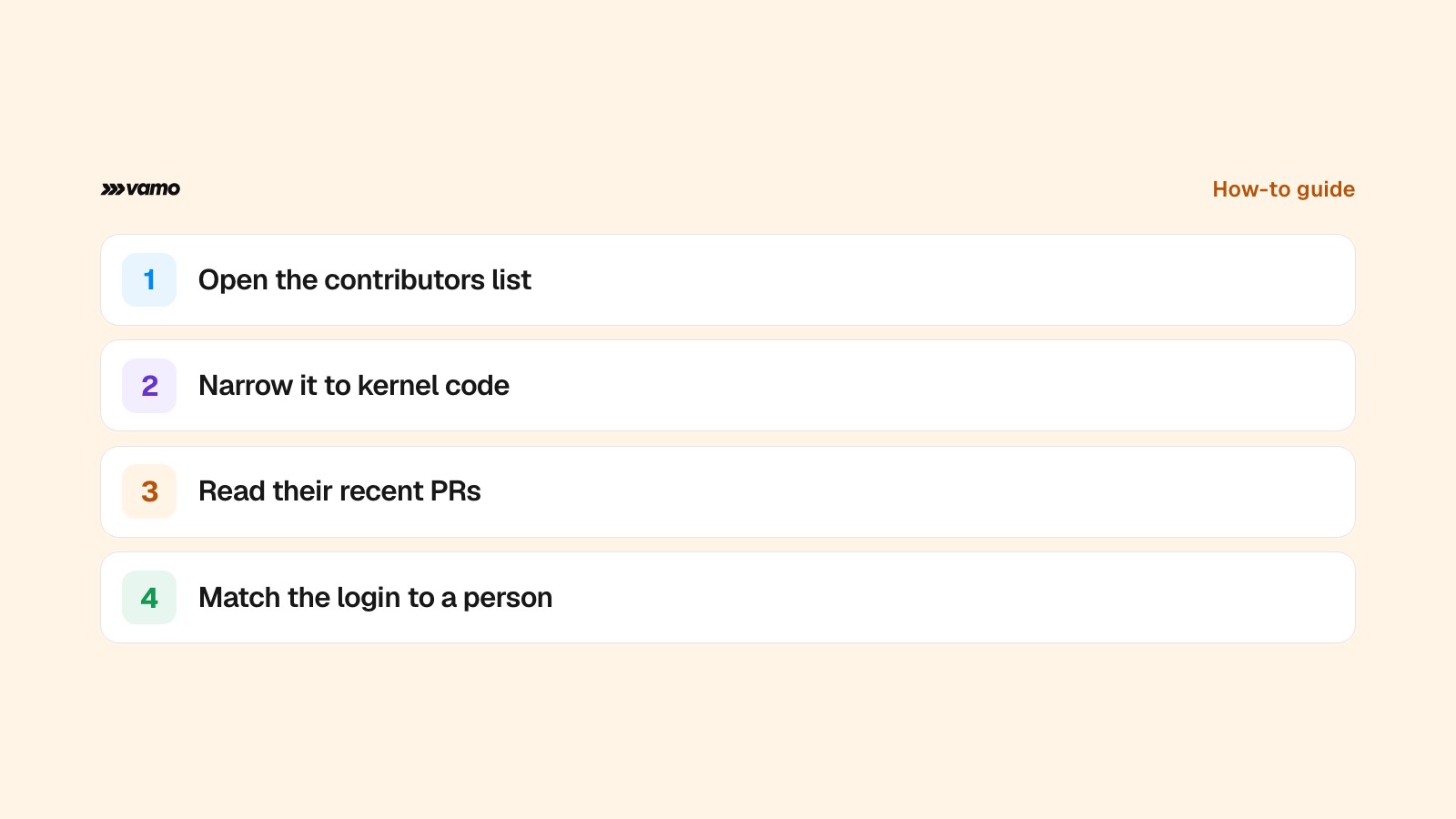
- Open the contributors list. Each repository has an Insights > Contributors page that charts commits per person over time. You can also call
gh api repos/triton-lang/triton/contributors?per_page=100to get logins and commit counts. - Narrow it to kernel code. Commit counts include docs and CI fixes, so look at who changed the kernel directories. In a local clone, run
git log --format='%an' -- csrc hopper | sort | uniq -c | sort -rnin flash-attention to count authors who touched the CUDA source. - Read their recent PRs. Filter the pull request list by author and read the last three merged PRs with the checklist above.
- Match the login to a person. Check the GitHub profile for a name, a company, a city and a personal site. This step takes the longest, because many kernel engineers leave their profile fields empty.
The method works, but it scales poorly. You repeat every step for each repository, and you still have to work out where each person lives and works today.
Ways to source CUDA engineers
| Method | What it finds | What it misses | Cost basis |
|---|---|---|---|
| GitHub contributor graphs by hand | Everyone who committed to a kernel repository, with commit counts and dates | Location, current employer and contact details; you look those up one person at a time | Free; it costs recruiter hours |
| LinkedIn Recruiter keyword search | People who list CUDA as a skill, with title, employer and city | Whether the person wrote a kernel; many strong kernel engineers have generic titles | A LinkedIn Recruiter seat license |
| Staffing marketplaces (Toptal and others) | Freelancers who tagged CUDA as a skill and passed the marketplace's own screening | Engineers who are employed full time and are not on the marketplace | Toptal's CUDA page, read November 23, 2026, offers a no-risk trial and says you pay only if satisfied; it publishes no rate |
| Specialist recruiters | Candidates from the recruiter's own network | Anyone outside that network | A fee set in your contract with the recruiter |
| Vamo | People who contributed to a named repository, filtered by city and employer | Kernel engineers whose work is private or happens only inside a company | Usage-based (book a demo) |
Riem.ai published a longer sourcing guide on hiring CUDA and GPU engineers in April 2026, which includes its own market estimates.
Searching by repository with Vamo
We built Vamo so that you can search people by the repositories they contributed to, and then filter by city and by current or former employer. You can ask for Triton contributors in the Bay Area who used to work at NVIDIA, and you get people rather than logins. You can see who builds a repository on our public pages for Triton and CUTLASS.
For other narrow stacks, read our guide to sourcing tools for niche tech stacks. We also compared the best tools to find engineers on GitHub and wrote about how to find engineers who are not on LinkedIn.
FAQ
Where do CUDA engineers publish their work?
CUDA engineers publish their work on GitHub in kernel libraries such as flash-attention, Triton, CUTLASS, DeepGEMM and ThunderKittens, and in the CUDA source folders of larger projects. Many of them also publish papers, and the paper usually links the repository where the kernel lives.
What is the difference between a CUDA engineer and an ML engineer?
An ML engineer trains and ships models with frameworks such as PyTorch. A CUDA engineer writes the GPU kernels that those frameworks call, and works on memory layout, tensor cores and the code paths for each GPU generation.
How do I evaluate a kernel engineer before an interview?
Read three of their merged pull requests in a kernel repository. Look for benchmark numbers on named hardware, code paths for a specific architecture such as Hopper, numerics tests, and clear answers to the maintainers in the review thread.
Is Triton experience a substitute for CUDA?
Triton experience covers a lot of the same ground, because engineers who write Triton kernels reason about tiling and memory movement on the GPU. Triton handles some low-level details for the author, so for work that needs hand control of each GPU generation, look for CUDA or CUTLASS commits as well.
Can I hire a kernel engineer who has no public code?
Yes, but you have to find them another way, such as referrals from the engineers who do have public work. Kernel engineers at large companies often work in private repositories, so ask the public contributors who they learned from and who they review code with.